
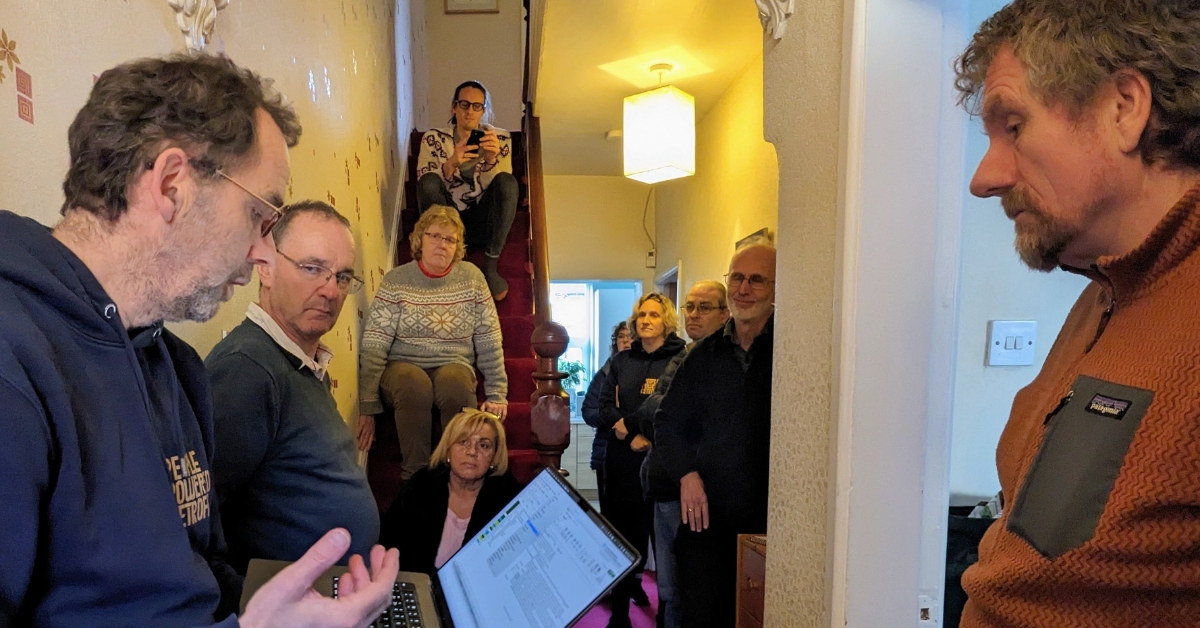
At the Home Energy Party we learnt where cold seeps into a home, where homes typically lose heat and some practical ways to make the home cosier.
‘I really enjoyed participating in Saturday’s Energy party. I must say I was a little apprehensive about the whole idea, but that quickly changed. I’ve shared most of what I learnt with family & friends, so thank you very much for your time and commitment to making us all more energy efficient.’ Susan, attendee
To broaden our understanding of how members could make their homes cosier, we supported People Powered Retrofit, a Manchester-based cooperative, and an air-tightness expert to run two Home Energy Parties on a cold January day. The homeowners who hosted the events invited friends and neighbours to search throughout the house for draughts and cold spots and we learnt to recognize signs of energy inefficiency.
Did you know
- A curtain in front of a drafty door isn’t enough, insulate around the door too.
- Warm air holds more moisture than cold air so when air hits a cold surface (like a window) it cools down and releases water, leading to condensation.
- Warm air rises, if it can escape through the loft the house acts like a giant chimney, and draws cold air through low level cracks.
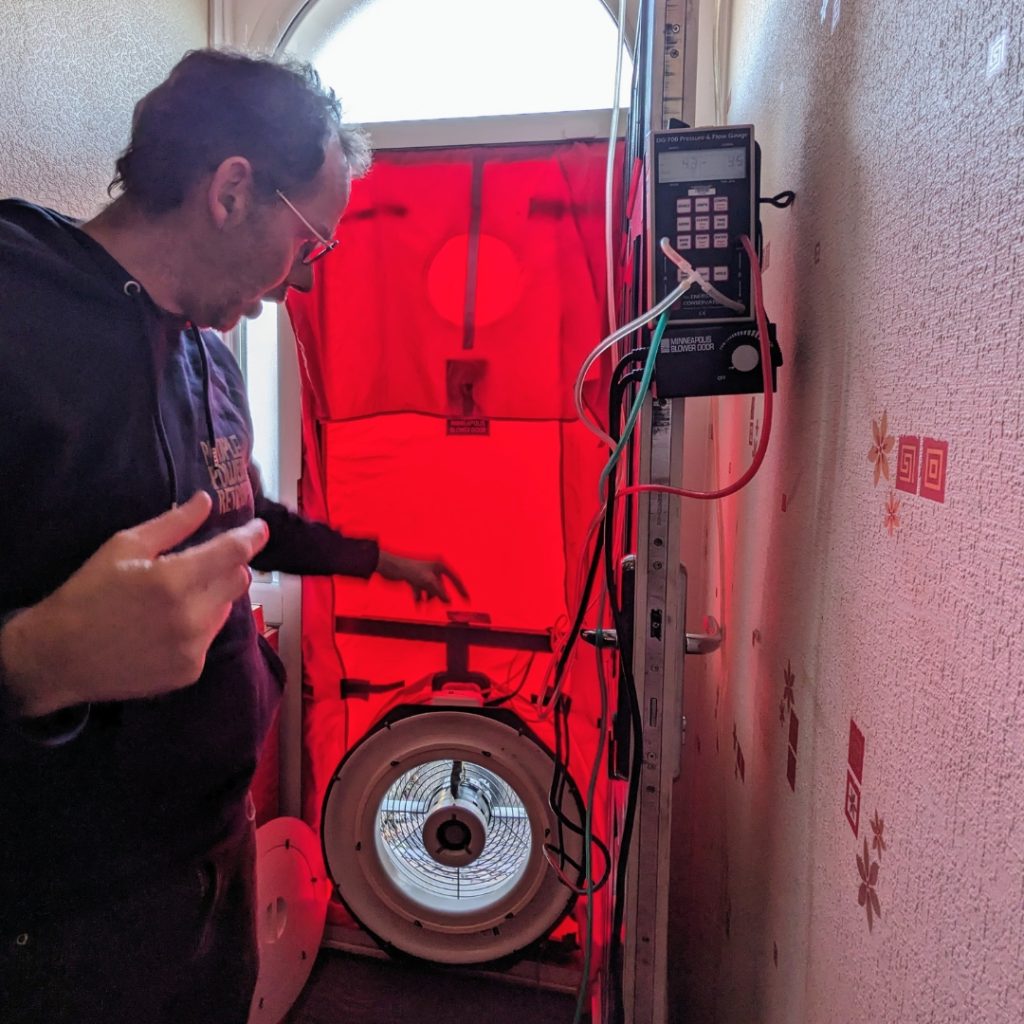
For the Home Energy Party test the bathroom and kitchen fans and the fireplace were sealed up and Gervase, People Powered Retrofit’s air tightness expert, sealed the front door to pressurize the house. He calculated that the total sum of the leakage holes in the house would be equivalent to a circular hole about 40cm in diameter. This house is better than the average but that’s still a lot of gaps for the cold to seep in!
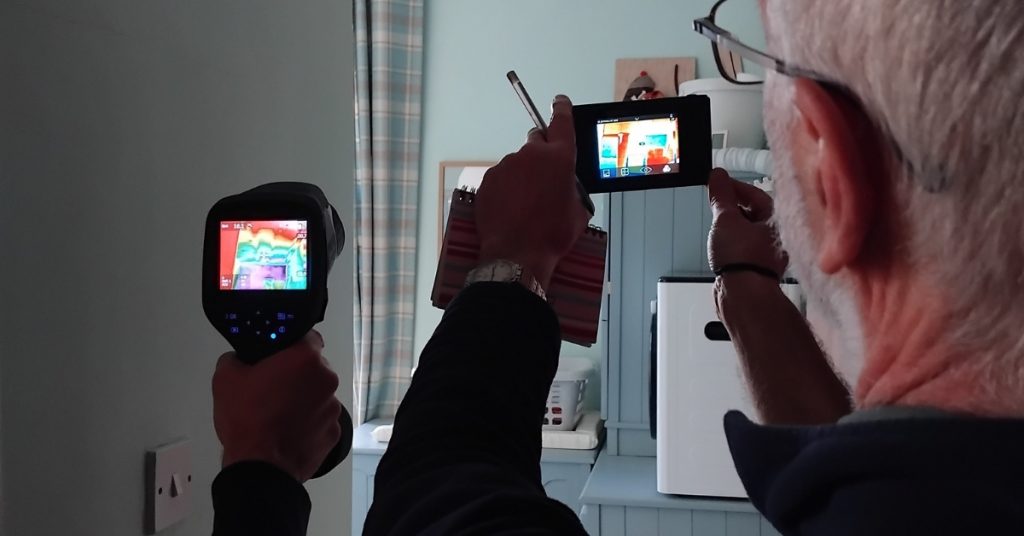
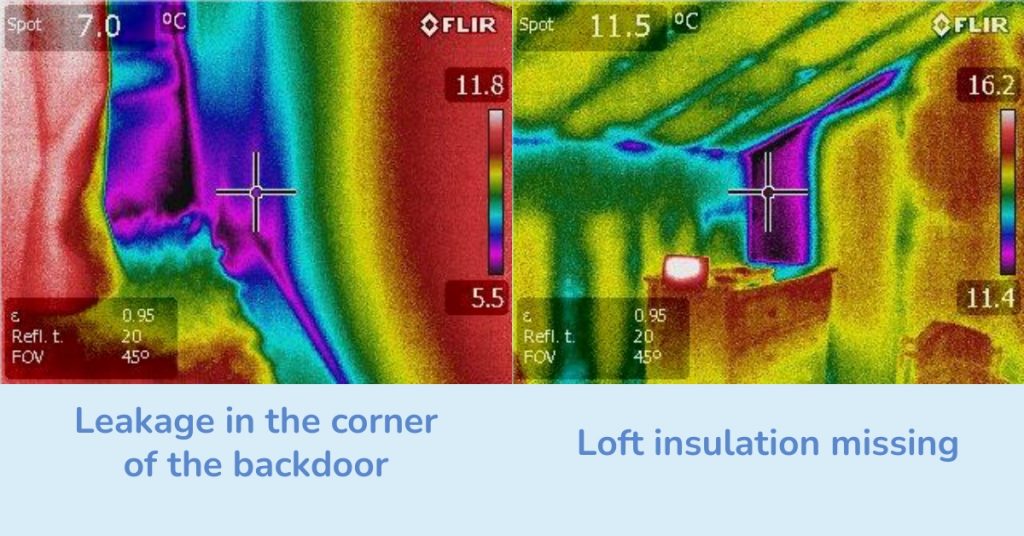
Armed with thermal imaging cameras we explored the whole house. The cameras show changes in temperature so we could clearly see cold spots. We found cracks and holes in the walls, gaps around doors and windows and patches where loft insulation was missing.
Gervase’s air tightness test can be seen in action on Channel 4’s Guy Martin’s House Without Bills (21 minutes into the program).
In these thermal camera images black/pink/dark blue shows areas that are colder than the surrounding areas.
‘The session was full of interesting and useful information. We learnt about all the little spots where hot air gets out and cold air enters the house! Some surprising places. We were surprised that our house is not at all well-sealed, even though we have done lots of work on it.’ Diana, host
‘I hadn’t realised the difference that small gaps were making. We’ve been hard at work in our house already with various doors, floor boards and other spaces being sealed up, and we can notice the difference already!’ Anne, host
Filling the gaps and increasing insulation should reduce the amount of energy you use to heat your home, but we were reminded that if we fill the gaps we must have adequate ventilation, such as extractor fans, to prevent damp. Bathrooms and kitchens are good locations for fans because that’s where most of the water vapor is produced.
DIY guide to finding cold spots and drafts
The equipment to pressurize a home is quite specialist and thermal imaging cameras can be expensive. So here are some tips to help you find drafts and cold spots in your own home.
How to look:
- Pick a windy day
- Use a wet finger or something lightweight that will move in a breeze such as the smoke from an incense stick, smoke pencil or feather duster.
- Mark drafty areas with masking tape so you can find them later.
Where to look:
- Anywhere in your home that potentially has a connection to the outside or cold/unheated areas of your home via holes, cracks, pipes, cables or any opening.
- Focus on looking around external doors and windows, under window sills, letter box, doors to cellar or porch, the loft hatch, skirting boards and floorboards, water, heating and waste pipes, electric sockets, cooker hoods, unused chimney and even your cat flap.
- Think about identify your heating zone and the areas that you don’t want or need to heat, such as the loft, porch and cellar. Can you seal doors and hatches to these areas.
And if you do want to buy a thermal imaging camera, there are cheaper versions which work with a smart phone and app.
How to fix:
- Armed with the information you can start to address some of the heat loss in your home.
- Things like expanding foam, insulation strips, loft insulation and balloons to seal a chimney.
Have you ever wanted to install a heat pump but you were concerned that your home would need substantial retrofit to sufficiently improve the energy efficiency? At the Home Energy Party we learnt that modest improvements might be enough for effective use of a heat pump.
If you are keen to understand more about homes and how to make them cosier, Channel 4’s Guy Martin’s House Without Bills and the Beginnner’s Guide to ECO renovation by Judith Leary-Joyce are packed with useful information.
If you are interested in South Manchester Credit Union’s green blogs, green loans, and savings accounts, please contact Ali Crush at ali@smcreditunion.co.uk to register your interest.
People Powered Retrofit offer tailored advice, home retrofit assessments and help with progressing renovation projects. You can find out more about their services here, and there are details of how People Powered Retrofit clients can access South Manchester Credit Union loans here.